Motion User Guide
- Welcome
- What’s new
-
- Intro to basic compositing
-
- Intro to transforming layers
-
- Intro to transforming layers in the canvas
- Transform layer properties in the canvas
- Transform tools
- Change layer position, scale, or rotation
- Move a layer’s anchor point
- Add a drop shadow to a layer
- Distort or shear a layer
- Crop a layer
- Modify shape or mask points
- Transform text glyphs and other object attributes
- Align layers in the canvas
- Transform layers in the HUD
- Transform 2D layers in 3D space
-
- Intro to the Timeline
- Display or resize the Timing pane
-
- Edit in the Timeline
- Move objects in the Timeline
- Distribute objects in the Timeline
- Trim objects in the Timeline
- Slip video layers in the Timeline
- Split objects in the Timeline
- Delete objects in the Timeline
- Copy and paste objects in the Timeline
- Group tracks in the Timeline
- Edit the group track in the Timeline
- Navigate in the Timeline
- Show and modify keyframes in the Timeline
- Edit in the mini-Timeline
-
- Intro to behaviors
- Behaviors versus keyframes
-
- Intro to behavior types
-
- Intro to Parameter behaviors
- Audio behavior
- Average behavior
- Clamp behavior
- Custom behavior
- Add a Custom behavior
- Exponential behavior
- Link behavior
- Use the Link behavior to control text strings
- Logarithmic behavior
- MIDI behavior
- Add a MIDI behavior
- Negate behavior
- Oscillate behavior
- Create a decaying oscillation
- Overshoot behavior
- Quantize behavior
- Ramp behavior
- Randomize behavior
- Rate behavior
- Reverse behavior
- Stop behavior
- Track behavior
- Wriggle behavior
-
- Intro to Simulation behaviors
- Align to Motion behavior
- Attracted To behavior
- Attractor behavior
- Drag behavior
- Drift Attracted To behavior
- Drift Attractor behavior
- Edge Collision behavior
- Gravity behavior
- Orbit Around behavior
- Random Motion behavior
- Repel behavior
- Repel From behavior
- Rotational Drag behavior
- Spring behavior
- Vortex behavior
- Wind behavior
- Additional behaviors
-
- Intro to shapes, masks, and paint strokes
- Edit fill, outline, and feathering
- Keyframe shape control points
- Convert between shapes and masks
- Using filters and masks with shapes
- Copy shape styles
- Save custom shapes and shape styles
-
- Intro to using generators
- Add a generator
-
- Intro to image generators
- Caustics generator
- Cellular generator
- Checkerboard generator
- Clouds generator
- Color Solid generator
- Concentric Polka Dots generator
- Concentric Shapes generator
- Gradient generator
- Grid generator
- Japanese Pattern generator
- Lens Flare generator
- Manga Lines generator
- Membrane generator
- Noise generator
- One Color Ray generator
- Op Art 1 generator
- Op Art 2 generator
- Op Art 3 generator
- Overlapping Circles generator
- Radial Bars generator
- Soft Gradient generator
- Spirals generator
- Spiral Drawing generator
- Use Spiral Drawing onscreen controls
- Star generator
- Stripes generator
- Sunburst generator
- Truchet Tiles generator
- Two Color Ray generator
- Save a custom generator
-
- Intro to filters
- Browse and preview filters
- Apply or remove filters
-
- Intro to filter types
-
- Intro to Color filters
- Brightness filter
- Channel Mixer filter
- Color Adjustments filter
- Color Balance filter
- Example: Color-balance two layers
- Color Curves filter
- Use the Color Curves filter
- Color Reduce filter
- Color Wheels filter
- Use the Color Wheels filter
- Colorize filter
- Contrast filter
- Custom LUT filter
- Use the Custom LUT filter
- Gamma filter
- Gradient Colorize filter
- HDR Tools filter
- Hue/Saturation filter
- Hue/Saturation Curves filter
- Use the Hue/Saturation Curves filter
- Levels filter
- Negative filter
- OpenEXR Tone Map filter
- Sepia filter
- Threshold filter
- Tint filter
-
- Intro to Distortion filters
- Black Hole filter
- Bulge filter
- Bump Map filter
- Disc Warp filter
- Droplet filter
- Earthquake filter
- Fisheye filter
- Flop filter
- Fun House filter
- Glass Block filter
- Glass Distortion
- Insect Eye filter
- Mirror filter
- Page Curl filter
- Poke filter
- Polar filter
- Refraction filter
- Ring Lens filter
- Ripple filter
- Scrape filter
- Sliced Scale filter
- Use the Sliced Scale filter
- Sphere filter
- Starburst filter
- Stripes filter
- Target filter
- Tiny Planet filter
- Twirl filter
- Underwater filter
- Wave filter
-
- Intro to Stylize filters
- Add Noise filter
- Bad Film filter
- Bad TV filter
- Circle Screen filter
- Circles filter
- Color Emboss filter
- Comic filter
- Crystallize filter
- Edges filter
- Extrude filter
- Fill filter
- Halftone filter
- Hatched Screen filter
- Highpass filter
- Indent filter
- Line Art filter
- Line Screen filter
- MinMax filter
- Noise Dissolve filter
- Pixellate filter
- Posterize filter
- Relief filter
- Slit Scan filter
- Slit Tunnel filter
- Texture Screen filter
- Vignette filter
- Wavy Screen filter
- About filters and color processing
- Publish filter controls to Final Cut Pro
- Using filters on alpha channels
- Filter performance
- Save custom filters
-
- Intro to 360-degree video
- 360-degree projects
- Create 360-degree projects
- Add 360-degree video to a project
- Create a tiny planet effect
- Reorient 360-degree media
- Creating 360-degree templates for Final Cut Pro
- 360-degree-aware filters and generators
- Export and share 360-degree projects
- Guidelines for better 360-degree projects
-
- Intro to exporting projects
- Export a QuickTime movie
- Export audio only
- Export a still image
- Export a still image to Pixelmator Pro
- Export an image sequence
- Export to Apple devices
- Export to email
- Export using Compressor
- Create share destinations
- Render settings
- View the status of shared items
- Share notifications
-
- Intro to settings and shortcuts
-
- Intro to Keyboard shortcuts
- Use function keys
- General keyboard shortcuts
- Audio list keyboard shortcuts
-
- Tools keyboard shortcuts
- Transform tool keyboard shortcuts
- Select/Transform tool keyboard shortcuts
- Crop tool keyboard shortcuts
- Edit Points tool keyboard shortcuts
- Edit shape tools keyboard shortcuts
- Pan and Zoom tools keyboard shortcuts
- Shape tools keyboard shortcuts
- Bezier tool keyboard shortcuts
- B-Spline tool keyboard shortcuts
- Paint Stroke tool keyboard shortcuts
- Text tool keyboard shortcuts
- Shape mask tools keyboard shortcuts
- Bezier Mask tool keyboard shortcuts
- B-Spline Mask tool keyboard shortcuts
- Magnetic Mask tool keyboard shortcuts
- Transport control keyboard shortcuts
- View option keyboard shortcuts
- HUD keyboard shortcuts
- Inspector keyboard shortcuts
- Keyframe Editor keyboard shortcuts
- Layers keyboard shortcuts
- Library keyboard shortcuts
- Media list keyboard shortcuts
- Timeline keyboard shortcuts
- Keyframing keyboard shortcuts
- Shape and Mask keyboard shortcuts
- 3D keyboard shortcuts
- Miscellaneous keyboard shortcuts
- Touch Bar shortcuts
- Move assets to another computer
- Work with GPUs
- Glossary
- Copyright and trademarks
Edit a Magnetic Mask in Motion
After you apply a Magnetic Mask to a clip, you can make detailed adjustments using tools in the Inspector or canvas. You can also use the Timeline to view, navigate, or delete reference frames indicating points in the clip where the mask was edited.
Refine a Magnetic Mask selection
In the Layers list or Timeline in Motion, select an applied Magnetic Mask, then position the playhead at a point within the clip that shows the area to be masked.
In the Magnetic Mask Inspector, click the Select Objects button
 .
.Do any of the following:
Add or remove areas from the mask with selection tools: Click the Add
 or Remove button
  in the Selection Tools row, then click an area in the canvas to add to or remove from the mask.
In the canvas, additional control points are shown to indicate areas added or removed from the mask, and a reference frame is added to the Timeline.
Add or remove areas from the mask with touch-up brushes: Click the Add
 or Remove
  button in the Touch-Up Brush Tools row, then drag across an area in the canvas to add or remove it. To adjust the size of the brush, drag the Brush Size slider in the Inspector.
Areas are added or removed from the mask based on the size of the brush and the brush strokes, and a brush tool edit (a white dot) is added to the Timeline.
Tip: To switch between eyedroppers or brushes temporarily, press and hold the Option key as you click or drag in the canvas. When you release the Option key, the tool reverts to the previously active eyedropper or brush.
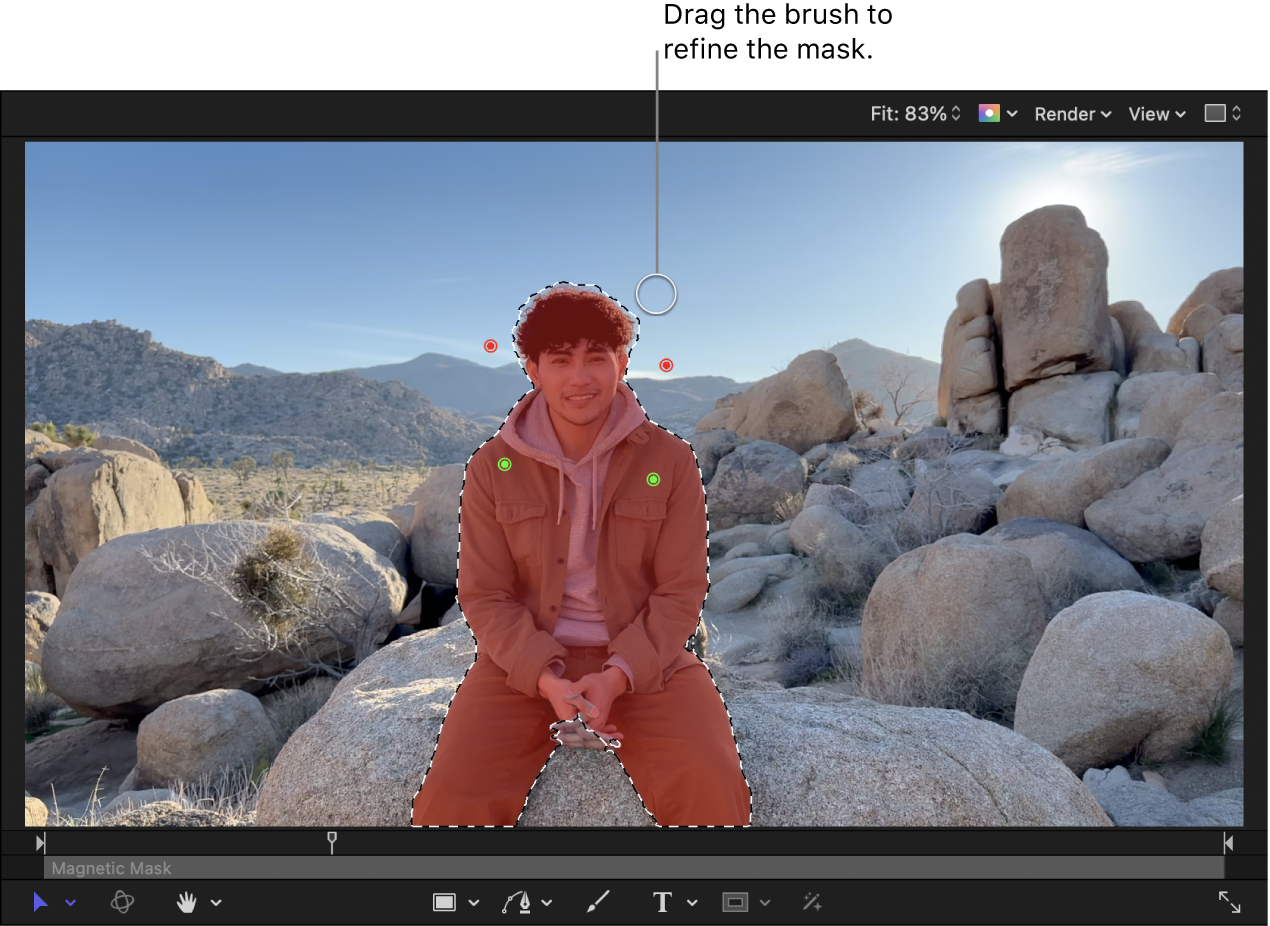
Tip: To see the size of the brush tool while you resize it, hold down the Shift key and drag in the viewer.
Soften the edge of the entire mask: Drag the Feather slider.
Positive feathering values soften the mask from its edge outward; negative values soften the mask from its edge inward. Feathering the edge of a mask can make the isolated object blend more easily with the background.
To specify whether the touch-up brush affects the mask before or after feathering, click the Apply Brushes pop-up menu, then choose Before Feather or After Feather.
Optional: To remove a mask (including any control points, brushstrokes, and analysis data) for a frame, click the Reset Frame button
 .
.
When you add control points, new reference frames are created. To navigate between reference frames, click  or
or  in the Inspector. To view reference frames in the timeline, see Edit Magnetic Masks in the Timeline.
Invert a Magnetic Mask
By default, a Magnetic Mask isolates people or objects from the background. You can quickly invert a mask—swapping its solid and transparent areas, to remove people or objects from the background rather than isolate them.
In the Layers list or Timeline in Motion, select an applied Magnetic Mask, then position the playhead at a point within the clip that shows the masked area.
In the Magnetic Mask Inspector, click the Show Result button
 , then select the Invert Mask checkbox.
Change the blend mode of a Magnetic Mask
In the Layers list or Timeline in Motion, select an applied Magnetic Mask, then position the playhead at a point within the clip that shows the masked area.
In the Magnetic Mask Inspector, click the Show Result button
.Click the Mask Blend Mode pop-up menu, then choose Add, Subtract, Replace, or Intersect.
Mask blend modes determine how a mask interacts with the clip’s alpha channel. See Mask controls in the Inspector.
Edit Magnetic Masks in the Timeline
When you add a Magnetic Mask to a clip, the Motion Timeline shows rendered analysis ranges, reference or analysis frames containing control points, and frames containing edits made with the touch-up brushes.
In the Motion Timeline, do any of the following:
Choose a mask to display in the canvas and Magnetic Mask Inspector: Click an analyzed frame range (the light gray bar below a Magnetic Mask timebar).
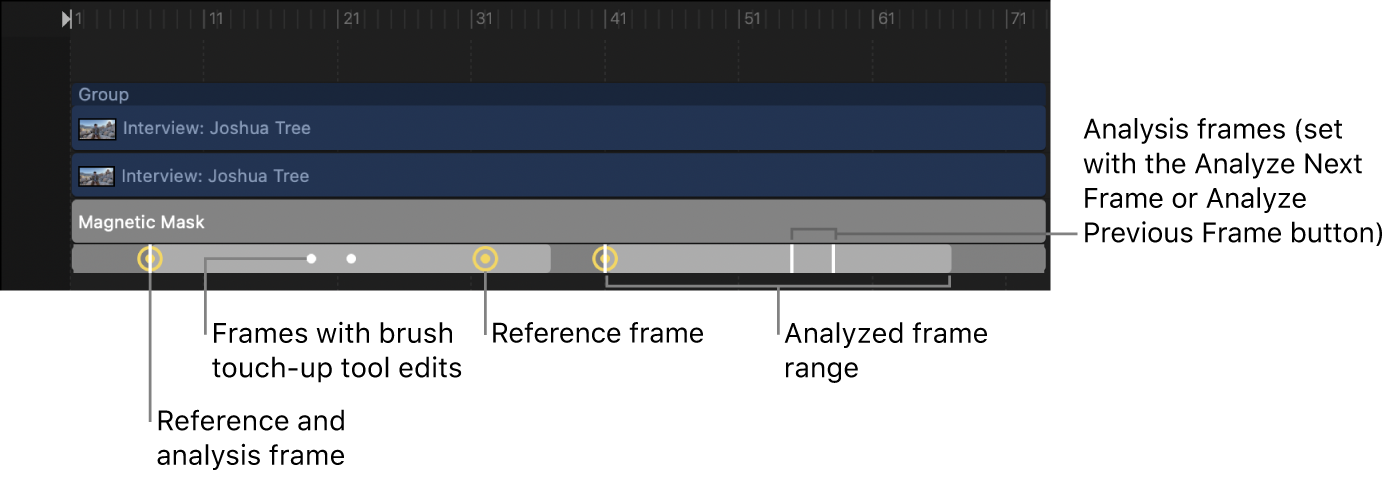
Remove a mask (including any control points, brushstrokes, and analysis data) for a single frame: Double-click a reference frame indicator, then click Reset Frame.
Download this guide: PDF