Final Cut Pro User Guide for Mac
- Welcome
- What’s new
-
- Intro to importing media
- If it’s your first import
- Organize files during import
-
- Import from Image Playground
- Import from iMovie for macOS
- Import from iMovie for iOS or iPadOS
- Import from Final Cut Pro for iPad
- Import from Final Cut Camera
- Import from Photos
- Import from Music
- Import from Apple TV
- Import from Motion
- Import from GarageBand and Logic Pro
- Import using workflow extensions
- Record into Final Cut Pro
- Memory cards and cables
- Supported media formats
-
-
- Intro to captions
-
- Closed captions workflow
- Create closed captions
- Import closed captions
- Show or hide closed captions
- Edit closed caption text
- Adjust and arrange closed captions
- Format closed caption text
- Create multilingual closed captions
- Convert closed captions to another format
- Convert closed captions to subtitles
- Export closed captions
- Generate subtitles automatically
-
- Intro to effects
-
- Intro to transitions
- How transitions are created
- Add transitions and fades
- Quickly add a transition with a keyboard shortcut
- Set the default duration for transitions
- Delete transitions
- Adjust transitions in the timeline
- Adjust transitions in the inspector and viewer
- Merge jump cuts with the Flow transition
- Adjust transitions with multiple images
- Modify transitions in Motion
- Add adjustment clips
-
- Add storylines
- Use the precision editor
- Conform frame sizes and rates
- Use XML to transfer projects
-
- Intro to sharing projects
- Share to Apple devices
- Share on the web
- Send a video frame to Pixelmator Pro
- Share in email
- Share stereo or spatial video
- Batch sharing
- Share using Compressor
- Create share destinations
- Change metadata for shared items
- View the status of shared items
- Speed up exports with simultaneous processing
- Glossary
- Copyright and trademarks
Show a two-up display in the viewer in Final Cut Pro for Mac
For more accurate visual feedback on edits involving contiguous or connected clips, you can see a “two-up” display in the viewer. For example, for a simple ripple edit, the two-up display shows the end point of the left clip and the start point of the right clip.
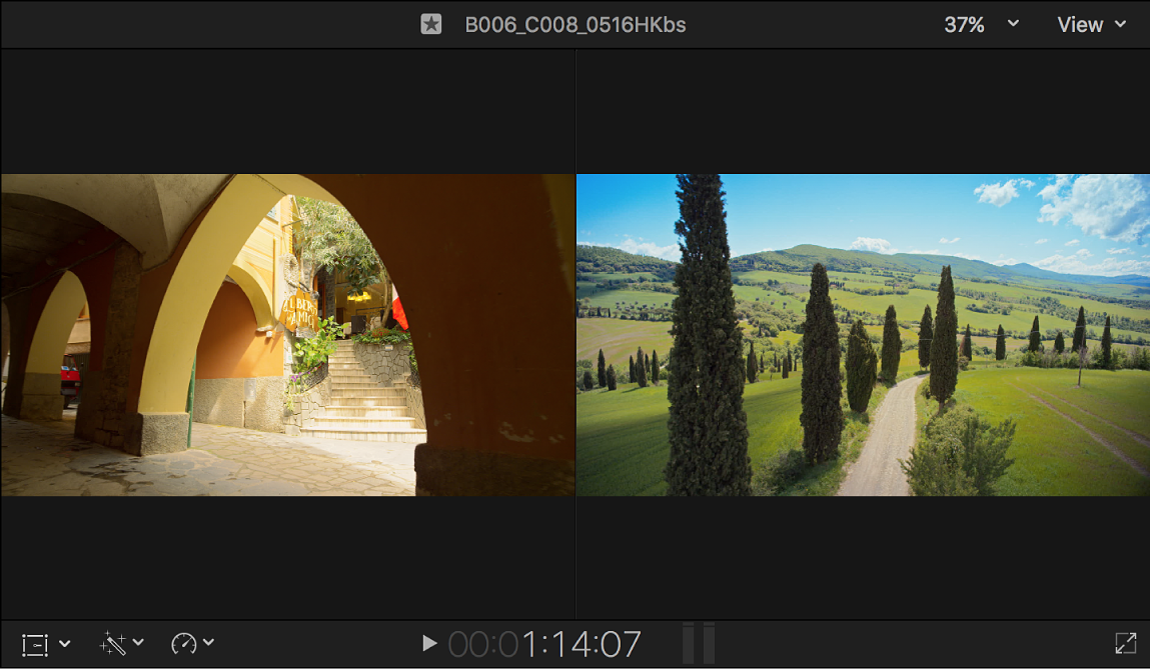
This display is available for ripple edits, roll edits, slip edits, and slide edits, as well as for trimming in the precision editor.
In Final Cut Pro for Mac, do one of the following:
Click the View pop-up menu in the upper-right corner of the viewer, then, in the Display section, choose “Show 2–Up When Trimming.” (When the two-up display is turned on, a checkmark appears.)
Press Option-U.
The two-up display appears in the viewer whenever you use a supported trim edit type or when you’re trimming in the precision editor.
You can use keyboard shortcuts to select and adjust edit points while the two-up display is shown.
Action | Shortcut | ||||||||||
|---|---|---|---|---|---|---|---|---|---|---|---|
Select the left edge of the edit point | Left Bracket ([) | ||||||||||
Select the right edge of the edit point | Right Bracket (]) | ||||||||||
Select both sides of the video edit point | Backslash (\) | ||||||||||
Select both sides of the audio edit point | Shift-Backslash (\) | ||||||||||
Move the edit point left by one frame | Comma (,) | ||||||||||
Move the edit point left by 10 frames | Shift-Comma (,) | ||||||||||
Move the edit point right by one frame | Period (.) | ||||||||||
Move the edit point right by 10 frames | Shift-Period (.) | ||||||||||
Move the edit point forward | Press Plus Sign (+), then type a timecode duration for the move | ||||||||||
Move the edit point back | Press Minus Sign (–), then type a timecode duration for the move | ||||||||||
Tip: You can use the Option key to change the two-up display on the fly. After you turn on the two-up display, press the Option key while trimming to temporarily turn it off. When the two-up display is off, press the Option key while trimming to temporarily switch the view between the end point of the left clip and the start point of the right clip.
Download this guide: PDF